Closed cell spray polyurethane foam is the densest, highest performing insulation we install, and in a Houston building it solves three problems in a single application: heat transfer, uncontrolled air movement, and moisture. This page explains what the product actually is, where it belongs, how a job runs, and what separates a good install from one you will be paying for twice.
What closed cell spray foam actually is
Closed cell foam arrives on the truck as two liquid components, kept separate and heated. They meet at the tip of the spray gun, react, and expand to roughly thirty times their liquid volume before curing into a rigid plastic. The name describes the cell structure: the tiny bubbles that make up the cured foam are sealed shut against each other, each one holding a low conductivity gas.
That sealed structure is the whole story. Because gas cannot move freely between cells, the foam resists heat conduction far better than a material full of open, connected air pockets. Because water cannot travel through it, the foam does not absorb, hold or wick moisture. And because the cured material is rigid rather than soft, it adds measurable stiffness to the assembly it is bonded to.
Cured closed cell foam typically weighs around two pounds per cubic foot. Pick up a scrap of it and it feels like dense polystyrene, not like a blanket. That density is why it costs more per board foot than any other option on this site, and also why it does jobs nothing else on this site can do.
How it performs
Thermal resistance
Closed cell foam delivers roughly R-6.5 per inch, against about R-3.7 for open cell foam and somewhere near R-3.0 to R-3.8 per inch for fibreglass depending on the product and how carefully it was installed. In practical terms, three inches of closed cell in a two by four wall gets you into the R-19 to R-20 range without furring the wall out or giving up interior space.
That matters most where the cavity is shallow and fixed. A two by four exterior wall, a rim joist, a van or trailer body, the underside of a metal roof panel: in all of these the depth is what it is, and the only way to raise the R value is to raise the R value per inch.
Air sealing
This is the part most homeowners underestimate. A published R value is measured in a laboratory with no air moving through the assembly. Real buildings leak, and in Houston that leakage carries hot, wet outside air directly into your conditioned space, all day, every day of summer.
Because closed cell foam is applied as a liquid and expands into every gap before it hardens, it seals the assembly as it insulates it. At around one and a half to two inches of thickness it qualifies as an air barrier in its own right. There is no separate air sealing step, no caulking every penetration, no hoping the crew remembered the top plate.
Moisture and vapour control
At roughly two inches and above, closed cell foam performs as a Class II vapour retarder. On the Gulf Coast, where outdoor dew points sit uncomfortably high for months at a time, that stops warm humid air from reaching a cool surface inside your wall or ceiling and condensing there. Condensation inside an assembly is what rots sheathing, corrodes fasteners and grows mould, and it happens invisibly until the damage is already done.
The foam is also not a food source. It does not support mould growth, and unlike cellulose or fibreglass it does not slump, sag or lose loft after it gets wet once.
Structural contribution
Because the cured foam bonds tightly to studs and sheathing, it ties the assembly together and meaningfully increases racking strength. On coastal and near coastal construction this is a genuine secondary benefit, not a marketing line.
Closed cell or open cell?
Both are spray polyurethane foam and both are installed with the same rig, but they behave very differently. The honest answer is that neither one wins every job.
- Choose closed cell when the cavity is shallow, when the assembly will see moisture, when the space is below grade or in a flood prone area, when you are insulating metal, or when you want the structural gain.
- Choose open cell when you have generous depth to fill, when sound dampening is the priority, when the assembly needs to dry inward, or when the budget per square foot is the deciding factor.
A lot of Houston homes end up with both: closed cell on the exterior walls and rim joists, open cell at the attic roof deck where there is plenty of rafter depth to work with. There is nothing wrong with mixing them, and it is often the most sensible use of the budget.
Where closed cell belongs in a Houston building
Exterior walls
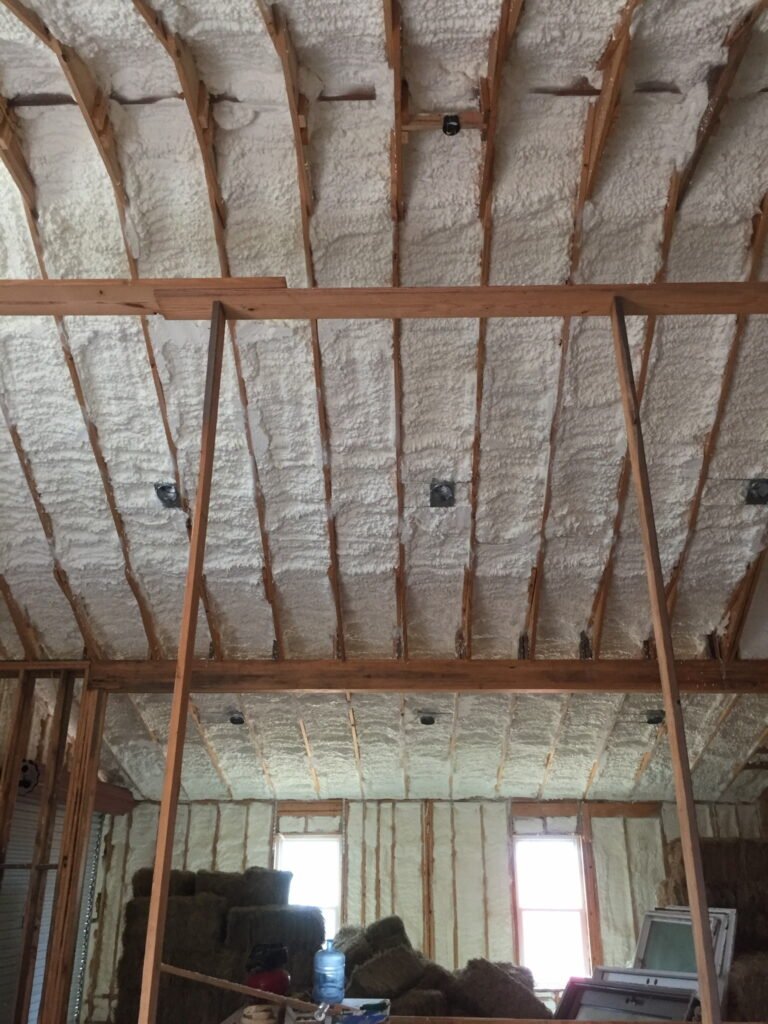
New construction and gut remodels are the easiest wins. We spray after rough in, before drywall, and trim flush to the studs. You get insulation, air sealing and vapour control in one trade visit instead of three.
Metal buildings, shops and pole barns
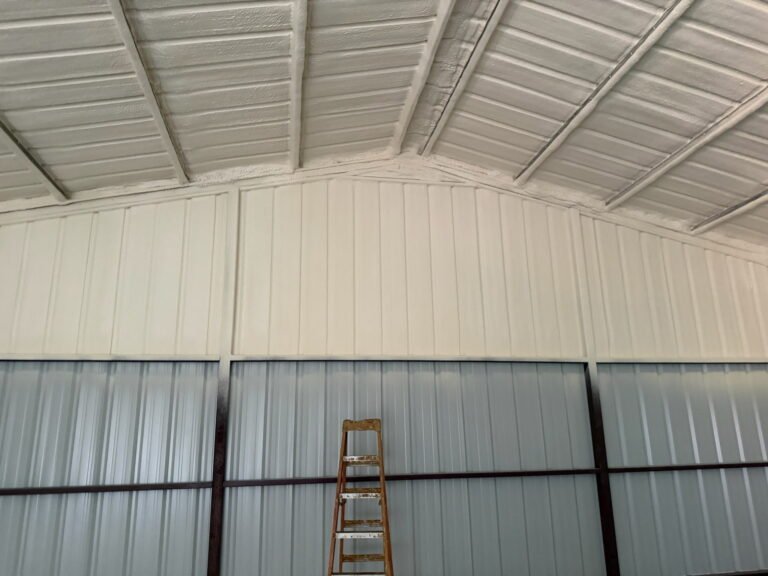
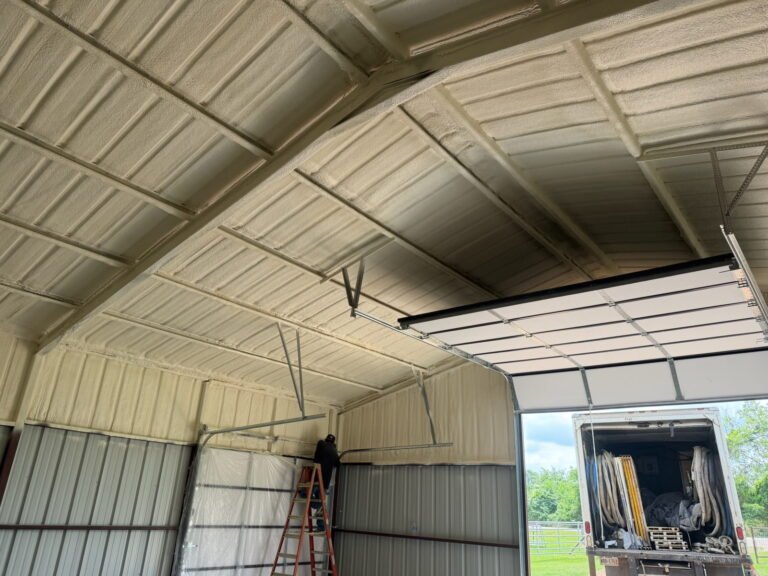
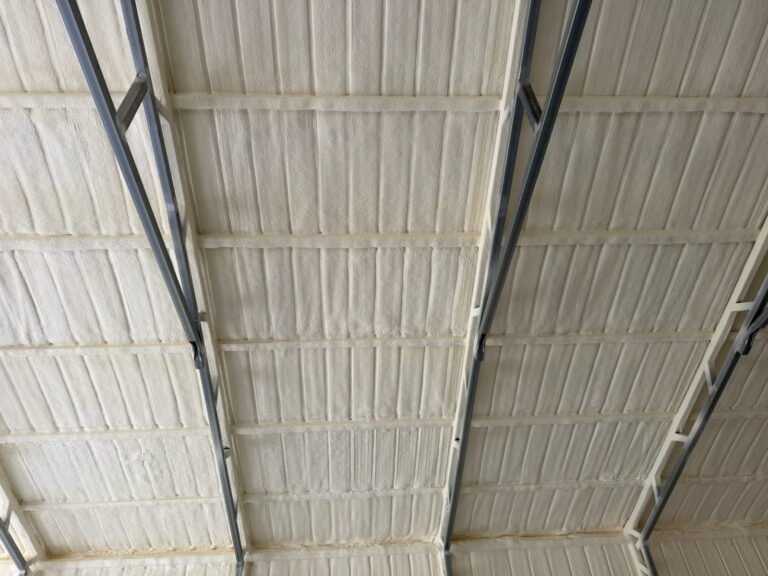
Bare metal panel plus humid Gulf air equals condensation dripping off the underside of the roof onto whatever is stored below. Closed cell sprayed directly to the panel eliminates the cold surface entirely, and because it adheres to the metal there is no cavity behind it for moist air to reach. This is the single most common commercial application we handle. See commercial and industrial insulation for how those projects are scheduled.
Crawl spaces and rim joists
The rim joist is the band of framing where the floor system meets the foundation, and in most older Houston homes it is either bare or stuffed with a scrap of batt. It is one of the largest single air leaks in the building. A few inches of closed cell here is a small job with a disproportionate effect on comfort.
Flood prone properties
Harris County homeowners know the drill. Closed cell foam does not absorb water, does not hold it against the framing, and does not have to be torn out and replaced after every event the way saturated batt insulation does. It is recognised as a flood resistant material, which matters for both recovery cost and peace of mind.
Low slope and metal roof assemblies
Where a roof deck needs both insulation and a moisture barrier, closed cell is usually the answer. Larger roof projects are often handled as a full sprayed roofing system instead. See roof insulation and metal roof coating.
How a closed cell job runs
- Inspection. We walk the building, measure the cavities, check for active leaks and existing damage, and look at where the ducts and equipment currently sit. We do not quote from a phone call and a square footage figure.
- Written proposal. You get the foam type, the installed depth, the exact areas covered and a fixed price. If any part of the building would be better served by a cheaper product, we say so in the proposal.
- Preparation. Existing material comes out if it needs to. See insulation removal. We mask windows, finished surfaces, electrical panels and anything else that must stay clean, and we set up ventilation.
- Application. Foam goes on in controlled lifts, usually no more than two inches at a pass, letting each lift cure before the next. Rushing this is the most common cause of a bad install: too thick a pass traps heat in the curing foam, which can scorch the core and leave the foam brittle or smelling.
- Trimming and cleanup. Anything proud of the framing is shaved flush so the drywall crew is not fighting us. Waste is bagged and hauled off the same day.
- Walkthrough. We go through the building with you, confirm depth and coverage, and tell you exactly when the space is ready to be occupied and closed up.
Safety, curing and building code
Spray foam is chemically reactive while it goes on and inert once cured. During application the crew works in supplied air respirators and full protective suits, and the building needs to be clear of anyone not in that gear. Re entry time depends on the product and the ventilation, and it is typically measured in hours rather than days. We will give you the specific figure for the product being used before we start, in writing.
Once cured, closed cell foam is stable and gives off nothing. It does, however, need to be covered. Building code requires spray foam in occupied space to be separated from the interior by a thermal barrier, most commonly half inch drywall. In an attic or crawl space that stays unoccupied, an approved ignition barrier coating may be permitted instead. We will tell you which applies to your project and price it accordingly rather than leaving you with a code problem at inspection.
What drives the price
We will not publish a per square foot number, because any contractor who quotes one before seeing the building is guessing. The variables that actually move the price are:
- Installed depth. Foam is sold by the board foot, which is one square foot at one inch. Doubling the depth roughly doubles the material.
- Total area and access. A clear new construction shell sprays quickly. A tight crawl space or a finished attic with a small hatch does not.
- Preparation and removal. If contaminated material has to come out first, that is its own scope of work.
- Masking. Occupied and finished spaces need far more protection than a bare shell.
- Complexity. Lots of penetrations, odd framing and obstructions all slow the crew down.
Closed cell costs more up front than fibreglass or open cell. Where it earns that back is in reduced cooling runtime, in avoiding moisture damage, and in not needing to be replaced. It is a permanent part of the building rather than a consumable.
What to ask any spray foam contractor
- What installed depth are you quoting, and what R value does that give me?
- Is that depth guaranteed at every point, or is it an average?
- How many lifts will you spray it in?
- Are you licensed and insured, and can I see the certificate?
- What is the re entry time for the product you are using?
- Who is responsible for the thermal or ignition barrier?
- What happens to the old insulation and the waste?
A contractor who cannot answer all seven without hesitating is not the one you want spraying a permanent material into your walls.
Lifespan and maintenance
Cured closed cell foam does not settle, sag, compress or degrade. It has no maintenance schedule. Under normal conditions it lasts the life of the structure, and because it is bonded to the framing rather than resting in a cavity, it does not shift when the building moves. The only realistic reasons to disturb it are a renovation that opens the assembly, or a roof leak that has to be traced and repaired.
Frequently asked questions
How thick does closed cell foam need to be?
It depends on the assembly and the target R value. Two inches is a common minimum on walls because that is roughly where the foam also becomes an air and vapour barrier. Metal buildings and roof decks often call for more. We specify the depth in the written proposal rather than leaving it open.
Will closed cell foam make my house too airtight?
A tight house is the goal. What a tight house then needs is controlled ventilation rather than random leakage, so on very tight projects we will flag whether mechanical fresh air is worth discussing with your HVAC contractor. Leaky is not the same as healthy.
Can it be sprayed over existing insulation?
No. Foam needs to bond to a clean, dry, structurally sound surface. Existing batt or blown material has to come out first, which is a separate scope. See insulation removal.
Does it smell?
There is a noticeable odour during application and while the foam cures. Properly mixed and applied in correct lifts, that odour clears with ventilation and does not persist. A lingering smell weeks later points to an off ratio mix or lifts sprayed too thick, which is an installation failure rather than a property of the product.
Is spray foam safe once it has cured?
Yes. The reactive chemistry happens during application. Cured foam is an inert plastic. The controls that matter are the crew wearing supplied air during the spray, the building being clear, and everyone respecting the re entry window we give you.
Will it stop pests getting in?
It removes the gaps and voids that rodents and insects travel through, and it is not a food source, so it is a strong deterrent. It is not a substitute for pest control, and it will not solve an infestation that is already established.
How much will it cut my electric bill?
We will not put a percentage on it, because the honest answer depends on your equipment, your ducts, your windows and how the house is used. What we can say is that in a Houston summer the attic and the envelope are where most of the load comes from, and sealing them is the highest leverage change available to most homes.
How long does a typical job take?
Most residential projects are one day on site. Larger commercial buildings are staged by bay or by area so you are not shut down. The written proposal includes the schedule.
Do you work outside Houston?
Yes, across the greater Houston metro including Katy, Cypress, Spring, Sugar Land, Tomball and Pasadena. If you are just outside that ring, call and ask.
Ready to price your project?
Tell us what the building is doing wrong and we will come and look at it. The inspection is free, the price comes in writing, and there is no pressure afterwards. Call (713) 281-9585 or request a free estimate.