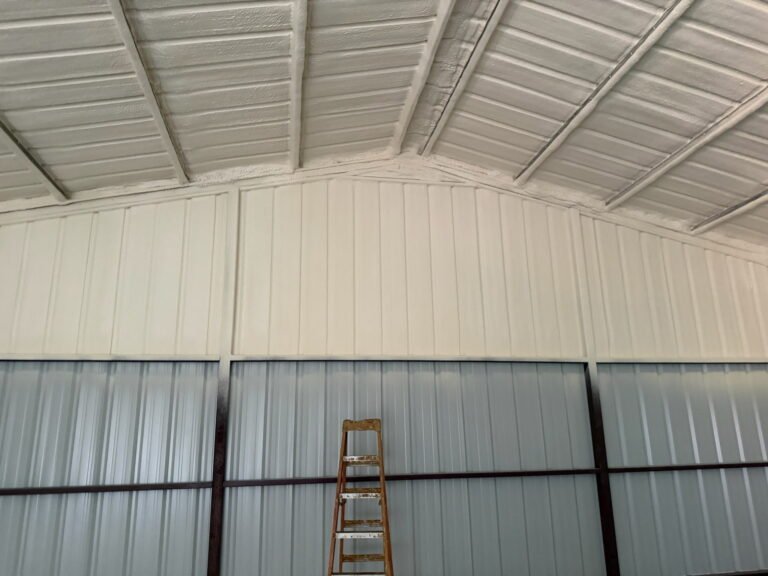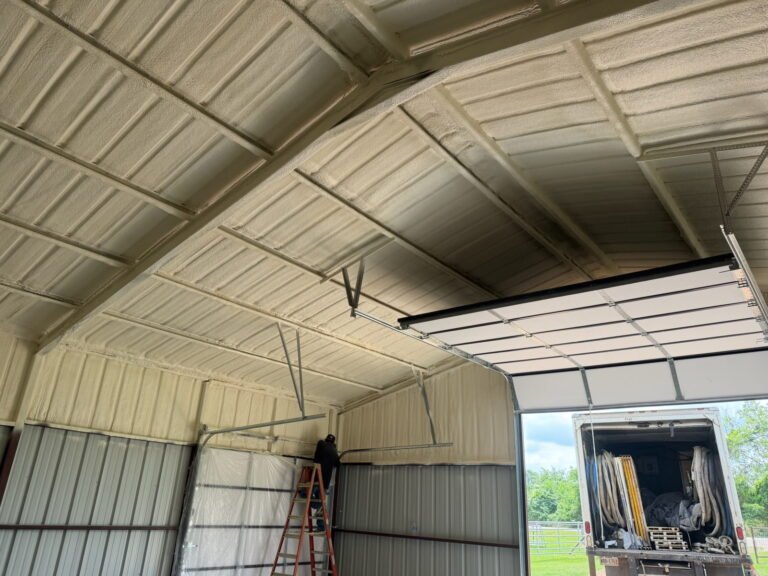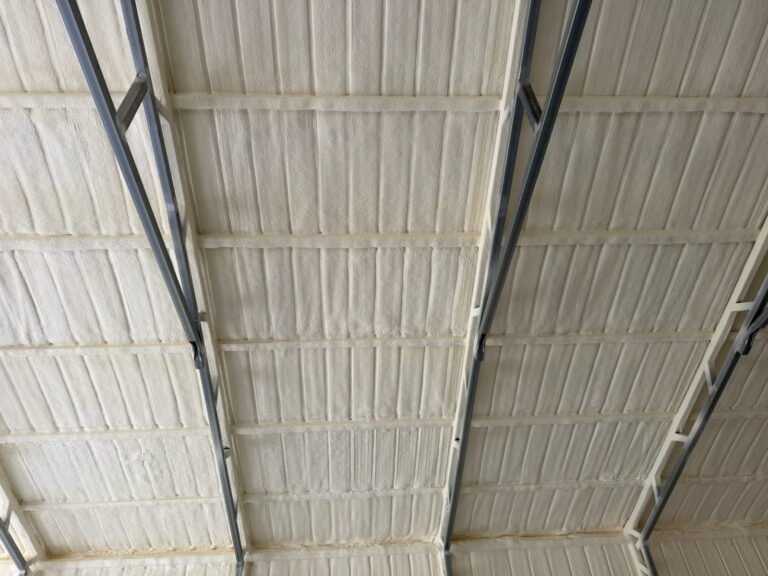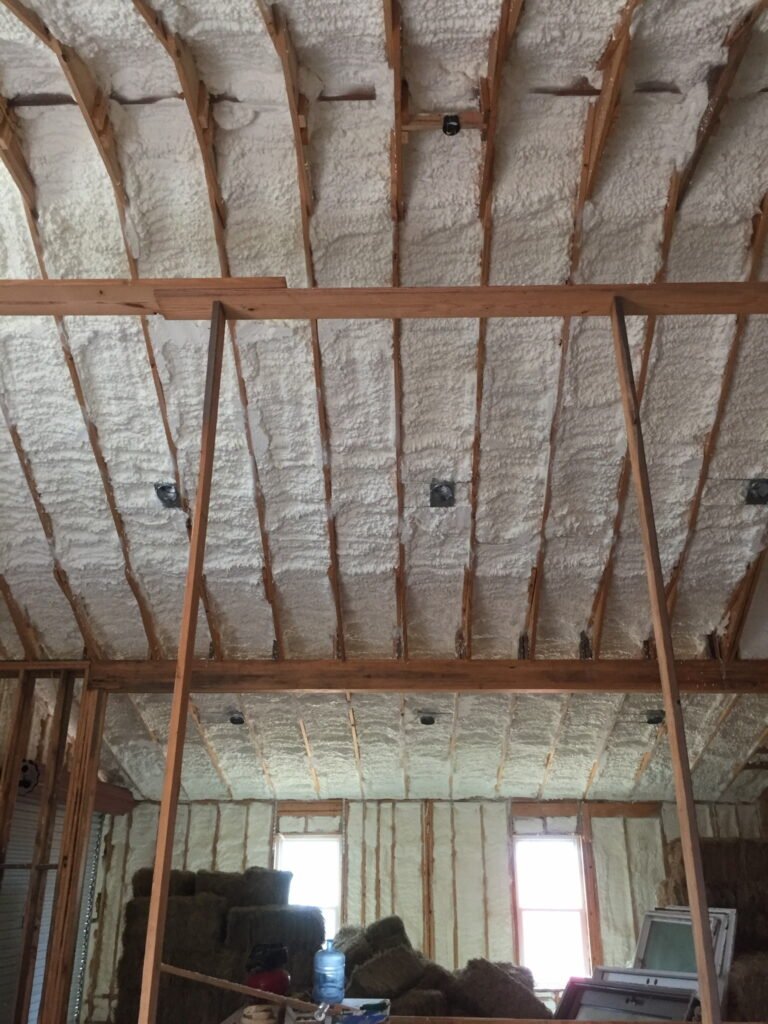
Open cell spray polyurethane foam is the lighter of the two spray foams we install, and on a lot of Houston jobs it is the smarter buy. It expands aggressively, fills awkward cavities completely, absorbs sound better than anything else we carry, and costs meaningfully less per square foot than closed cell. This page covers what it is, where it wins, where it does not belong, and what a proper installation looks like.
What open cell spray foam is
Like closed cell, open cell foam arrives as two heated liquid components that meet at the spray gun and react. The difference is in the chemistry and what happens next. Open cell expands enormously, roughly a hundred times its liquid volume, and cures with the cell walls broken open rather than sealed. The result is a soft, spongy, low density material that you can compress with your thumb.
Cured open cell weighs about half a pound per cubic foot, against roughly two pounds for closed cell. That is a quarter of the material doing the work, which is exactly why it costs less and why it fills a cavity so completely. When it goes off it pushes into every void, around every wire and pipe, and out past the face of the studs, where it is then trimmed flush.
How it performs
Thermal resistance
Open cell delivers roughly R-3.7 per inch. That is a little under fibreglass batt on paper and well under the R-6.5 of closed cell. Read in isolation that number makes open cell look like a poor deal, and it is the single most misunderstood figure in this trade.
The reason it still outperforms batt in the real world is that the published R value of a batt assumes a perfect, gap free, uncompressed installation that almost never happens on site. Open cell has no installation variable. It is a liquid that becomes the exact shape of the cavity, so the R value you specify is the R value you get across the whole plane, not just in the middle of each bay.
Air sealing
At around three and a half inches, open cell foam is an air barrier. In a climate where hot, humid outside air is being pushed into your building every hour of every summer day, stopping that air movement often matters more than the R value on the label. This is where open cell earns its keep.
Sound
The open, interconnected cell structure absorbs sound energy instead of reflecting it. Closed cell, being rigid and dense, does not. If the complaint is noise between bedrooms, road noise through a party wall, or a media room that carries through the house, open cell is the correct product and it is not close.
Vapour permeability
Open cell is vapour permeable, which means an assembly can dry inward through it. That is a genuine advantage in the right place: if a roof develops a small leak, water will show on the ceiling below rather than being trapped invisibly against the deck. It is also the reason open cell is the wrong choice in some assemblies, which is covered below.
Where open cell belongs
Attic roof decks
This is the most common residential application in Houston. Rafter bays are deep, so the extra thickness open cell needs is available at no cost, and the price per square foot is far kinder than closed cell across a whole roof plane. Spraying the deck and sealing the vents brings the attic inside the conditioned envelope, which takes your ducts and air handler out of a 140 degree space. See attic insulation for how that decision is made.
Interior partition walls
Bedrooms, offices, media rooms, bathrooms and any wall shared with a noisy space. Open cell in an interior partition is bought for acoustics rather than energy, and it is one of the cheapest quality of life upgrades available during a remodel.
Vaulted and cathedral ceilings
Deep rafter bays with no attic above them. Open cell fills the full depth and seals the ridge and eave details that are almost impossible to get right with batt.
Budget conscious retrofits
When the whole envelope needs attention and the budget will not stretch to closed cell everywhere, the sensible split is usually open cell across the large areas and closed cell reserved for the walls, rim joists and anywhere moisture is in play.
Where open cell does not belong
- Below grade or in contact with the ground. It will absorb and hold water. Use closed cell.
- Directly against metal panel. Because it is permeable, humid air can still reach the cold metal and condense behind the foam. Metal buildings get closed cell. See commercial and industrial insulation.
- Flood prone areas. Saturated open cell has to come out and be replaced.
- Shallow cavities where you need maximum R. There is no room for the depth it needs.
- Where the assembly needs structural stiffening. Open cell adds none.
How an open cell job runs
- Inspection. We measure the cavity depth, check the roof for active leaks, look at where the ducts sit and confirm the venting strategy before anything is quoted.
- Written proposal. Foam type, installed depth, exact areas, fixed price. If part of the job is better served by closed cell or by fibreglass, that is stated in the proposal rather than discovered later.
- Preparation. Old material out if required, see insulation removal. Masking, ventilation, and protection of anything that must stay clean.
- Application. Open cell can be sprayed in thicker passes than closed cell because it does not build heat the same way, but depth still has to be controlled and consistent.
- Trimming. Open cell always overexpands past the framing. It is shaved flush with a saw so drywall sits properly. Anyone who skips this step is leaving you a problem.
- Walkthrough and cleanup. Depth confirmed, trimmings bagged and removed, re entry time given in writing.
Code, safety and covering
The same rules apply as for any spray foam. The crew works in supplied air respirators, the building stays clear during application and for the re entry window we specify, and the cured foam must be separated from occupied space by a thermal barrier, usually half inch drywall. In an unoccupied attic an approved ignition barrier coating may be permitted instead. We price whichever one your project actually requires.
What drives the price
Open cell is sold by the board foot in the same way as closed cell, and the same variables move the number: installed depth, total area, how hard the space is to access, how much masking an occupied building needs, and whether existing material has to be removed first. Because open cell needs more inches for the same R value but costs far less per inch, it is usually the cheaper route to a given performance target wherever the depth exists.
Open cell in Houston specifically
Climate decides insulation strategy far more than most homeowners realise, and Houston sits in one of the more demanding zones in the country. We are in a hot humid climate with a long cooling season, a short and mild heating season, and outdoor dew points that stay high for months. That combination changes which product belongs where.
In a cold climate the priority is keeping expensive heat inside and stopping warm interior air from condensing inside a cold wall. In Houston the flow runs the other way for most of the year. Hot, wet outdoor air wants to push inward toward your cooled interior, and the condensing surface is on the inside of the assembly rather than the outside. Any advice you read written for a northern climate needs translating before you apply it here, and a lot of what circulates online does not get translated.
What this means for open cell in practice is straightforward. In a vented attic assembly where the foam is on the roof deck and the space becomes conditioned, open cell performs extremely well and its permeability is an asset, because a roof leak announces itself instead of hiding. In an exterior wall exposed to months of high dew point air, that same permeability is a liability, and closed cell is the better specification. Same product, same building, different answer depending on which plane you are insulating.
How open cell compares to what you probably have now
Most Houston homes built before the last decade have either blown fibreglass or cellulose on the attic floor and fibreglass batt in the walls. Both were installed to the code of the day and both have almost certainly lost performance since.
- Against blown fibreglass. Loose fill settles, drifts away from the perimeter, and gets disturbed every time someone walks through the attic to service equipment. Open cell does not move once it is cured.
- Against cellulose. Cellulose is a good insulator that behaves badly around moisture. It absorbs, compacts and can support mould growth. Open cell does none of those things.
- Against batt. Batt is only as good as the install, and it is almost never as good as the install. Every wire, pipe, brace and outlet box is a compromise. Foam removes that variable entirely.
If your existing material is dry and undisturbed, we will tell you honestly whether replacing it is worth your money. Sometimes the answer is that a targeted air sealing job and some added depth gets you most of the benefit for a fraction of the cost. In that case a targeted air sealing job with some added depth is usually the better spend than a full foam retrofit.
What a bad open cell install looks like
Because open cell is forgiving to spray, it attracts operators who are not careful. The failures we get called out to fix are consistent:
- Untrimmed foam. Open cell always overexpands past the framing. If it is not shaved flush, the drywall will not sit properly and you will see it in the finished wall.
- Inconsistent depth. Thin in the corners, heavy in the easy middle. The thin spots are where the performance goes.
- Missed penetrations. Around plumbing stacks, at the top plate, behind ductwork. These are the exact places air actually moves.
- Sprayed over damp or dirty substrate. The foam will not bond, and it will eventually pull away.
- Partial vent sealing in an attic. Sealing some vents and leaving others creates air movement through the assembly with nowhere controlled to go.
All five are avoidable with an unhurried crew and a supervisor who checks the work before the rig is packed up. That is the whole difference.
Frequently asked questions
Is open cell foam worse than closed cell?
No, it is different. Closed cell wins on R per inch, moisture resistance and rigidity. Open cell wins on sound absorption, cost per square foot and cavity fill. The right question is which one suits the assembly, not which is better in the abstract.
How thick does open cell need to be?
Around three and a half inches to act as an air barrier, and more where you are chasing a specific R value. Attic roof decks are commonly sprayed considerably deeper because the rafter depth allows it. The proposal states the exact figure.
Will open cell hold water if my roof leaks?
It can absorb water, but because it is vapour permeable a leak shows itself on the ceiling below rather than hiding. That is a real advantage over a material that would conceal the problem. Any wet foam still needs to be cut out and replaced once the leak is repaired.
Does open cell foam sag or settle over time?
No. It is bonded to the framing rather than resting in the cavity, so it stays where it was sprayed for the life of the building. It does not compress, slump or lose loft the way loose fill and batt do.
Can I put open cell in my exterior walls?
You can, and in a dry, well detailed wall it performs. In Houston we usually recommend closed cell on exterior walls because the vapour control and the higher R per inch both matter in a shallow cavity facing a humid climate.
How much noise will it actually stop?
Enough that most clients notice immediately between rooms. It absorbs airborne sound well. It does not stop impact noise such as footsteps overhead, which is a structural problem rather than an insulation one.
Does it smell after installation?
There is an odour during spraying and curing that clears with ventilation. A smell that persists for weeks indicates an off ratio mix or poor application, not a normal property of the product.
Do you serve my area?
We cover Houston and the surrounding metro including Katy, Cypress, Spring, Sugar Land, Tomball and Pasadena. Call if you are just outside that ring.
Get a price for your building
We inspect before we quote, always. Call (713) 281-9585 or request a free estimate and we will tell you whether open cell is the right call for your job or whether your money is better spent elsewhere.